Building on top of the OpenClaw ecosystem — with a focus on privacy, security, and personal infrastructure
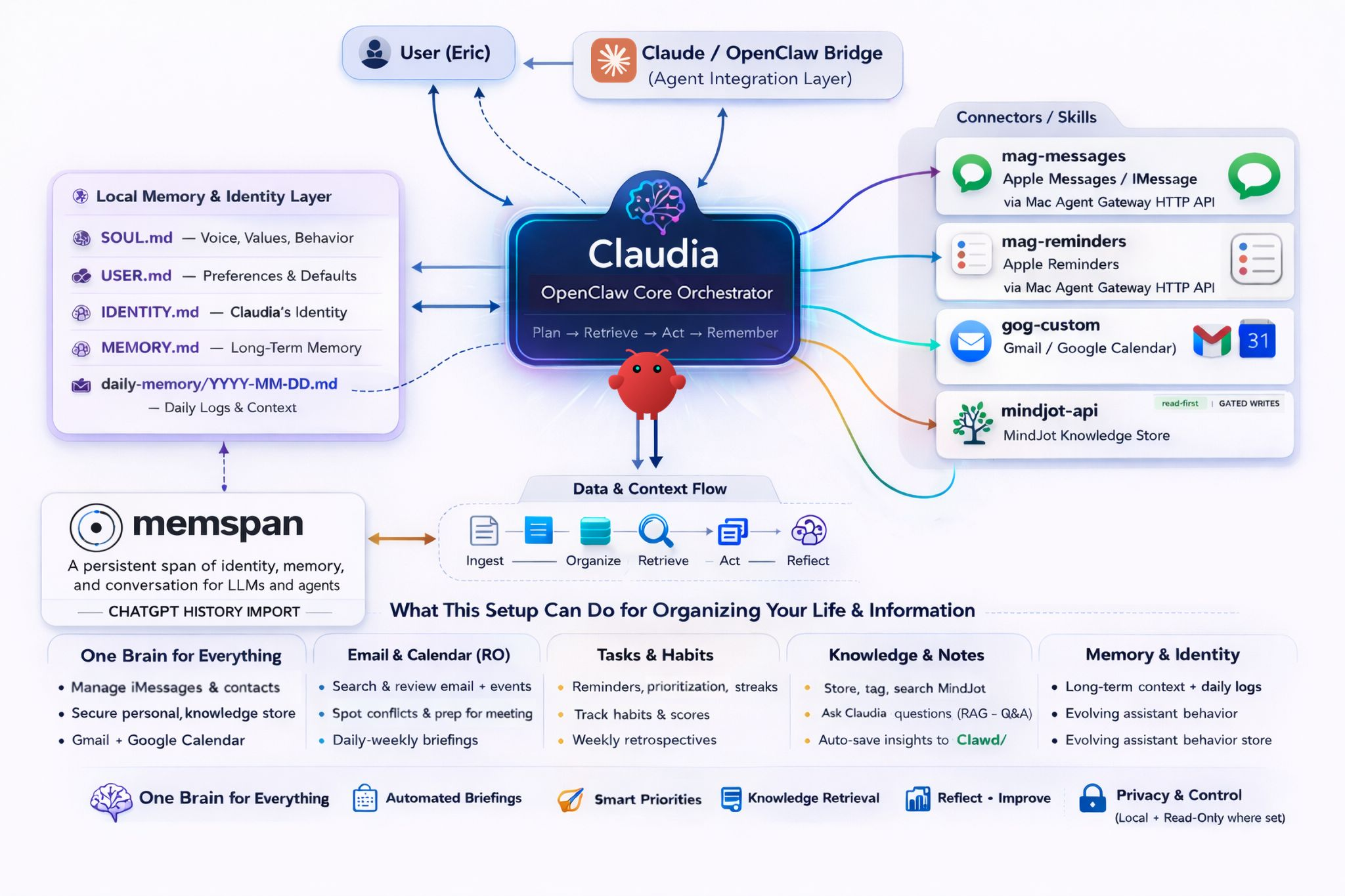
There’s been a huge amount of momentum recently around OpenClaw / ClawBot-style agent systems. A lot of people are experimenting with agents, subagents, and skills.
I’ve been exploring that ecosystem as well, but from a slightly different angle.
Instead of building a generic AI assistant, I’ve been focusing on something more personal:
How do you wire an agent system into your actual life while keeping control of your data? The result is the architecture below.
At the center is Claudia (My personal AI assistant’s name & Clawdbot Core Orchestrator) running inside my own sandboxed environment.
Around that core I integrated several systems that matter to my workflows:
• Apple Messages + Reminders via a Mac Agent Gateway
• Read-only Gmail + Google Calendar (by design)
• A habit tracking engine (sprints, streaks, retrospectives)
• MindJot knowledge store for PKM + RAG
• Local memory + identity layer (SOUL.md, USER.md, long-term memory)
• Memspan for identity/personality + persistent memory + ChatGPT history import/export
• A Claude ↔ OpenClaw bridge enabling agent relay + subagent collaboration
A few design principles guided this build:
1️⃣ Privacy first
Sensitive data stays local whenever possible.
Examples:
– Local memory layer
– Local PKM store
– Read-only integrations where appropriate
– Explicitly gated writes to knowledge systems
2️⃣ Agents should adapt to your workflows
Instead of forcing everything into one platform, the system connects to:
– my existing APIs
– my knowledge store
– my messaging tools
– my productivity stack
– The agent orchestrates them rather than replacing them.
3️⃣ Composable agent systems
One of the most interesting experiments here is the Claude ↔ OpenClaw bridge.
It allows Claude Code to relay requests to an OpenClaw agent via an OpenAI-compatible endpoint.
That means Claude can effectively act as a router or collaborator with OpenClaw and its subagents.
So you get a layered architecture:
Claude
→ Bridge
→ OpenClaw
→ Skills / subagents
→ Memory + tools
That pattern opens up a lot of interesting possibilities for agent collaboration.
Open source components behind this
I’ve open-sourced the key pieces that power this system:
Claude ↔ OpenClaw Bridge https://github.com/ericblue/claude-openclaw-bridge
Memspan — persistent memory layer https://github.com/ericblue/memspan
MAC – Mac Agent Gateway https://github.com/ericblue/mac-agent-gateway
Habit Sprint https://github.com/ericblue/habit-sprint
There’s still a lot of experimentation happening in the OpenClaw ecosystem, but what’s exciting right now is how quickly people are building skills, integrations, and agent architectures on top of it.
Curious to see where this space goes next.
If you’re building agents, memory systems, or personal AI infrastructure, I’d love to hear what you’re experimenting with.